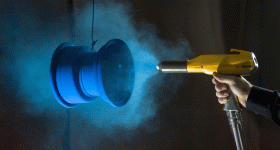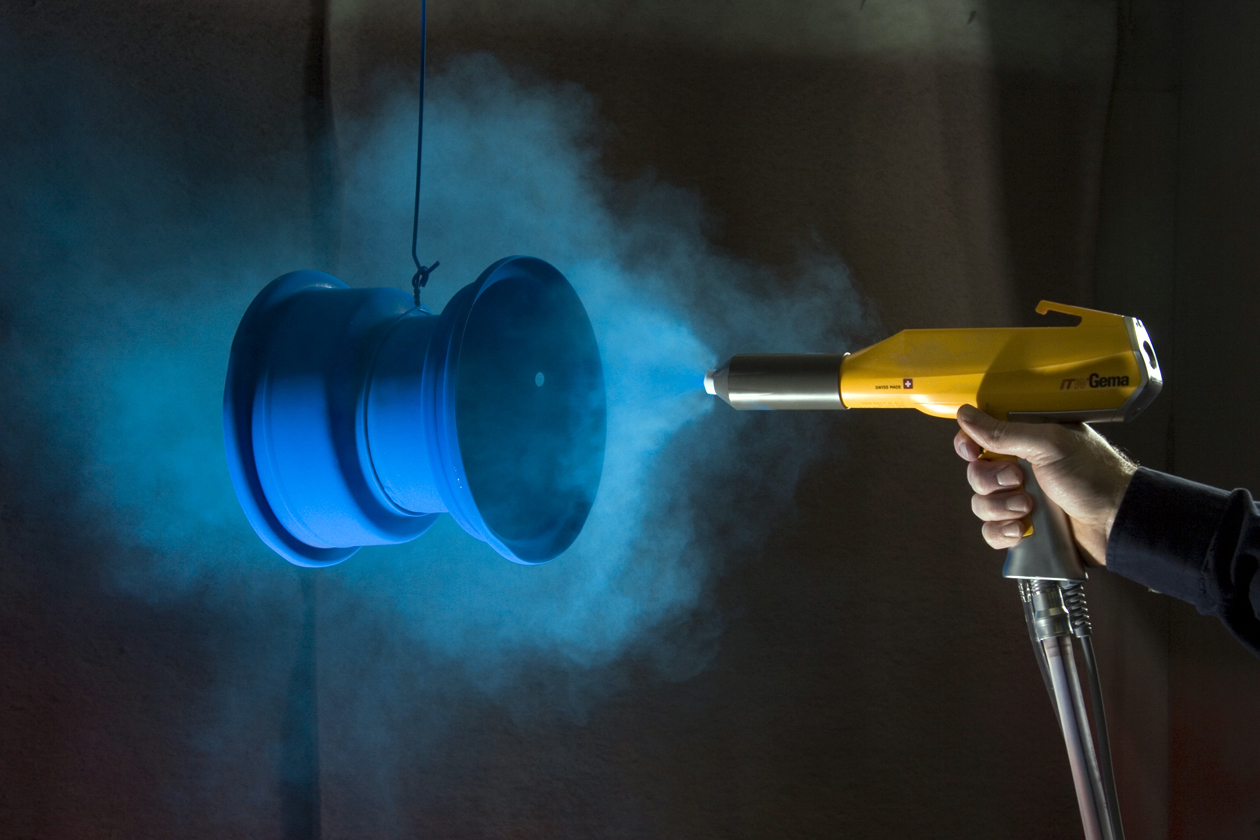
Powder coating is a dry final coating process in which an electrical charge causes the powder to weld to the metal surface.
Then the coating is baked in the oven and a uniform surface is obtained. Powder coatings do not contain solvents, as a result, they can be applied in a greater thickness than normal liquid coatings, without sagging, and they have the least difference in appearance between surfaces with horizontal coating and surfaces with vertical coating. Powder coatings are based on polymer resin systems combined with curing agents, pigments, leveling agents, flow modifiers and other additives. These materials are melted, mixed and turned into a uniform powder by cooling and crushing the film, and are finally applied to the surface and baked in the oven. Figure 1 shows the continuous production process of powder coatings.

Image1. Schematic of continuous production of powder coatings
Powder coating production process
Compared to other coatings, the production process of a powder coating has differences such as complexity, long production time, and the need for more equipment. Each of the necessary equipment for making powder coating is explained below, in the order of their use:
1) premix
The first step in making a powder coating is the pre-mixing step. This stage is the most important stage of production. Different sizes of resin, pigment powder, etc. must be converted into a homogeneous mixture of similar particle size before entering the next step – extrusion. Since the extruder is a simple melt mixer and not a very efficient spreader, the premixing step must provide the best dispersion of the ingredients in the final product. Therefore, pre-mixing is done in equipment with sufficient ability to break up large pieces of resin, thoroughly mix the liquid components and disperse the components used in smaller quantities (such as additives).
The pre-mixing stage equipment consists of a mixing tank with a lockable lid. This equipment usually has a cooling jacket that can be filled with running water or, in rare cases, with cooling gases. The stirring blades inside the tank may have different shapes. However, there are usually two or three blades at different heights and orientations relative to each other.
2) extrusion
The second stage of powder coating production is extrusion. The extruder basically consists of a horizontal stainless steel cylinder. Inside the cylinder there are one or two "screws" whose diameter is slightly smaller than that. The screws rotate and advance the premix through the heated "mixing zones". The mixing zones have special joints called mixing vanes or blades. The blades knead the melted mixture and mix the different ingredients together. Contrary to what is thought, if pre-mixing is not done, the extruder will not be a good spreader. The space between the screws and the walls of the extruder is relatively large and allows the material to pass through without being completely dispersed. Also, the components pass through it quickly and do not have much time to disperse effectively.
There are three main types of extruders. The first type, single screw extruder, which is mostly used in the plastic industry. This type of extruder pushes the material slowly and is often not suitable for thermosetting coatings that may gel quickly.
The second type of extruder is an asymmetrically rotating twin screw extruder. This type consists of two screws that are placed together and rotate in opposite directions (one clockwise and the other counter-clockwise). This type of extruder is usually used in the plastic industry.
The third type of extruder that is used in the production of powder coating is the twin-screw extruder. In this type, two screws rotate side by side in the same direction. This action significantly increases the operational capacity and reduces the dwell time. Reducing the residence time in thermostatic coatings is important, especially in active systems with short gel times.

Image2. The type of extruder screws suitable for powder coatings
3) Mill
The grinding step in making a powder coating is important for its final performance. The average size and distribution of particles is of particular importance in the properties and appearance of the final surface of the coating. Once a powder coating is extruded, it goes through one or more steps to prepare it for milling. The molten material is poured on cool metal rollers and cooled, then the coating enters the mill in the form of filling.
There are three main types of mills in the powder coating industry: impact or hammer mills, air jet mills, and air classification mills. An impact or hammer mill crushes materials by throwing them or striking them against a stationary plate. Then the particles are transferred to different sieves or cyclone separators for final adjustment of particle size distribution.
Air jet mill is a very efficient mill. Powder coatings enter the air stream with high volume and speed. These particles form around the cylindrical mill chamber and collide with other particles and break them into very fine powders. Fine materials are removed from the chamber with exhaust air and transferred to the separation and particle size distribution devices.
Air classifier mill has elements of both previous types of mills. In this type of mill, there is an impact chamber that is supplemented with air currents and rapidly crushes the coating material. This type of mill has good control in particle size distribution and minimizes thermal effects such as particle adhesion.
4) Sieve and mesh
The final structure of the particle size distribution is done by passing the material through side removal filters or cyclone separators. Side removal filters consist of a type of cylinder that has bags with different meshes. The powder particles enter these bags and are separated from the surrounding filters. On the other hand, the principle of cyclone separators is to create centrifugal force by using vertical air flow in devices that cause a kind of spiral rotation in the powder by entering high-speed air into the tank. In this way, the heaviest (biggest) particles fall to the bottom of the chamber and are recycled, collected or disposed of as waste. The smallest particles that fall out with the air from above, flow through the ducts and, if needed, are stored or thrown away. By adjusting the volume and velocity of air flow, the particle size distribution can be changed. Below are the advantages and disadvantages of silicone filters compared to side removal filters.